Solo exhibition presented by Anant Art, at the Twin Gallery IGNCA, New Delhi 2018

Catalogue text: Shivani Karmakar
Urban landscapes have normalised infrastructural ubiquities. A precisely ordered system guides not just physical movement across the city but also thought and perception. The constant presence of this system results in internalising linearity, leaving one devoid of the different participants and possibilities that any given space and time can offer.
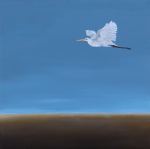
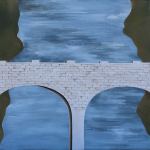
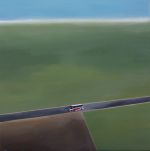
Riding across a highway bridge on her way to work in Yadgir in North-East Karnataka, Malavika Rajnarayan began to notice butterflies and dragonflies regularly crossing her path. The migratory insects would fly perpendicular to the human traffic, which consisted primarily of migrant labourers travelling in search of work. This intersection became rather poetic, with the movement of both the insects and the labourers being temporally motivated. They shared the same space and moment, but remained largely unknown and seemingly insignificant to each other’s sensibilities.
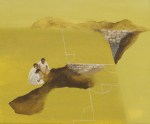
Inspired by such diversity, the essence of Malavika’s art is to explore contextual multitudes, particularly those existing outside the dominant thesis. She is drawn to the non-urban – as concrete often disconnects, while the openness of smaller towns and villages can be conducive to intimate interactions and deeper human relations.
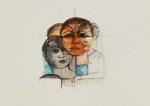
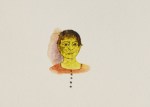
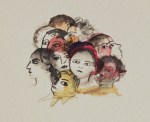
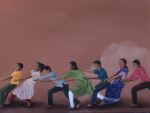
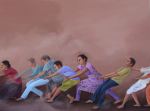
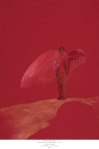
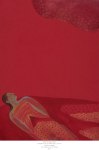
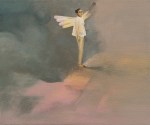
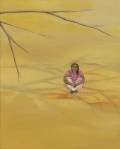
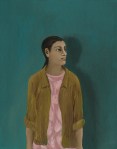
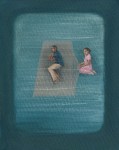
The pith of her work is also born out of an intrigue for the human. Malavika often paints the human figure in her art not to understand the form, but to explore its sensibilities: the “grace, strength, fragility, femininity, communion…”. Even when there is no explicit depiction of the human form, its evocation is apparent. Her approach to painting is thus more akin to an engagement with the phenomenological existence of the other – an existence that often blurs with her own in the process.
Such explorations are translated in the articulation of her work, which is consistent in its feminine softness even as this evocation is not conscious or necessarily intrinsic to her own being. Growing up in a progressive environment free from stereotypical notions of womanhood, Malavika has been intrigued by the socially embedded virtues of femininity and the counterintuitive strength it carries. This strength is aesthetically married to delicate strokes, making her work remarkably striking even in its softness. The art is further enhanced by deep reflections on the aesthetics and politics of different communities, landscapes, and cultural factions.
She is inspired by the politics of painters from various traditions who have radically defied conventions in an attempt to innovate while at once keeping the structures of their respective traditions intact. Malavika adopts this ideology in her own work by regularly revisiting her ideas in search of something new. The dyad of continuity and constructive disruption is a phenomenon that one often encounters in such an approach. How does one remain engaged in repetition? Can innovation arise out of continuity? What would such an endeavour entail? Malavika is interested in identifying the moment when the necessity to deviate reveals itself, and develop a practice that would allow the artist to act on this revelation.
She is also deeply inspired by the miniature tradition of painting. Their methodology of painting from introspective knowledge has become an integral part of Malavika’s own work. Rooted in knowledge and cultural traditions, her approach to art has always been sans-agenda. As she explains it, the process of creating art for her is similar to a conversation. “The process demands a sensitivity from me . . . to observe and respond to the painting as it pans out. It makes some room for unexpected discoveries.” This approach makes it possible for Malavika’s paintings to reveal that which would otherwise remain hidden, both within her and on the canvas.
This almost instinctive approach to art brings a quality of playfulness to her work. For her, such an approach allows child-like optimism and uninhibited creation, making it possible to reach for something beyond the human capacity.












 Malavika Rajnarayan